Bohemian garnet and healing
Under the reign of Rudolf II, Prague became the centre of European stone-cutting. Rudolf II was not only an avid collector of rarities and art objects, but his court also housed a large number of scholars and scientists, including many doctors, healers, herbalists and charlatans. One of the most eminent doctors was Rudolf II’s personal doctor, the Dutchman Anselmus de Boodt, also called Anselmus Boëtius de Boodt (1550, Bruges – 21 June 1632, Bruges). During his life, he wrote “Gemmarum et Lapi- dum Historia”, a very interesting work dealing also with the healing powers of gem- stones, including garnet from the Central Bohemian Uplands. In his work, he calls garnets “Granati Bohemici”, so he was the first person known to use the designation “Bohemian garnet”. He mentions their occurrence, mining and use. In the Middle Ages, precious stones were commonly attributed healing, sometimes even super- natural powers. Anselmus Boëtius de Boodt attributed Bohemian garnets a healing effect on mental illnesses, considering them also a means of increasing libido.
Another interesting doctor was Georgius Agricola (24 March 1494, Glauchau, Saxony – 21 November 1555, Chemnitz). This town doctor, as well as the father of modern mineralogy, worked in Jáchymov, a town of silver, arsenic and later also cobalt, nickel and uranium. Agricola tried to gain knowledge of metals, their compounds and possible applications of these substances in medicine. His key work is twelve books on mining, “De Re Metallica Libri XII”, which he published in 1556. The books, sum- marizing both contemporary knowledge and Agricola’s own findings, became the most widely used handbooks for mining and metallurgical processing of ores for at least 200 years. In 1546 Georgius Agricola (real name Georg Bauer) was the first to describe the mineral almandine from the garnet group from the site of Alabanda in what is now Turkey, after which almandine was named.
Garnets are still used in traditional medicine, e.g. in Southeast Asia, some parts of Mongolia, central Africa and elsewhere.
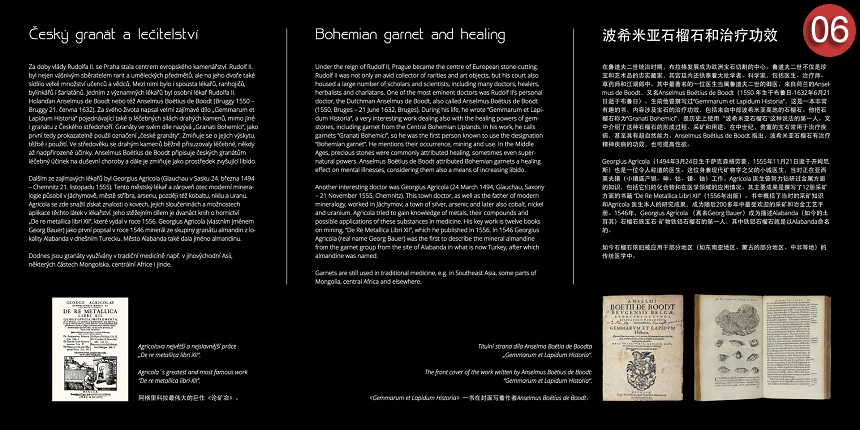
Agricola ́s greatest and most famous work “De re metallica libri XII“.
The front cover of the work written by Anselmus Boëtius de Boodt: “Gemmarum et Lapidum Historia“.