From the history of garnets
Garnets are undoubtedly among the oldest known minerals and precious stones, used in ancient times for decorative and ritual purposes. Mention of them can be found in Peri Lithon, a work by the Greek philosopher Theophrastus of Ephesus (372–287 BC). Garnets are also mentioned by the famous Roman polymath Pliny the Elder (23–79 AD) in his 37-volume encyclopaedia Naturalis Historia, where he referred to them as “carbunculus” (he probably meant almandines). They were known in ancient Greece and Rome, Carthage and other civilized countries of North Africa.
The designation “garnet” is probably derived from the Latin word “granum”, i.e. grain. The name comes from the 13th century, when it was used for the first time by the German theologian and phi- losopher Albertus Magnus (1193–1280). Another theory says that the name originated from the Latin phrase “malum granatum”, i.e. pomegranate (according to the most frequent garnet colour).
Garnets in Bohemia are also mentioned by Georgius Agricola (formaly name Jiří Bauer), a naturalist and doctor from Jáchymov, in his De Natura Fossilium Libri X (1494–1555).
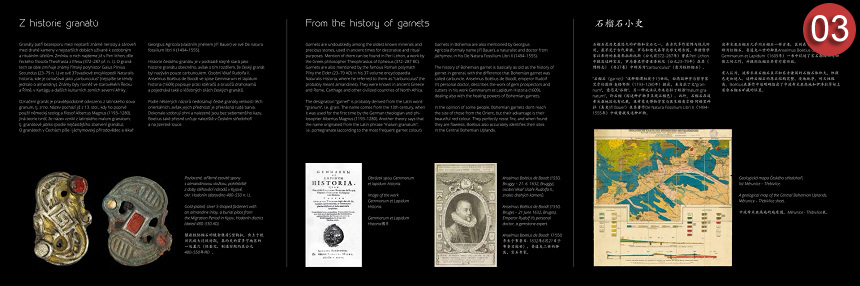
The history of Bohemian garnet is basically as old as the history of garnet in general, with the difference that Bohemian garnet was called carbuncle. Anselmus Boëtius de Boodt, emperor Rudolf II’s personal doctor, describes the work of gem prospectors and cutters in his work Gemmarum et Lapidum Historia (1609), dealing also with the healing powers of Bohemian garnets.
In the opinion of some people, Bohemian garnets don’t reach the size of those from the Orient, but their advantage is their beautiful red colour. They perfectly resist fire, and when found they are flawless. Boëtius also accurately identifies their sites in the Central Bohemian Uplands.
Gold-plated, silver S-shaped fasteners with an almandine inlay, a burial place from the Migration Period in Kyjov, Hodonín district (dated 480–550 AD).
Image of the work Gemmarum et Lapidum Historia.
Anselmus Boëtius de Boodt (1550, Bruges – 21 June 1632, Bruges), Emperor Rudolf II’s personal doctor, a gemstone expert.
A geological map of the Central Bohemian Uplands, Měrunice – Třebívlice sheet.