The history of mining – I.
The first “mining” of Bohemian garnets in the Central Bohemian Uplands was their manual collection from the topsoil, which is poor in garnets, ideally after rain, when garnet grains are very easily visible. According to several authors, another primitive method of mining was preserved in some places in this area, virtually unchanged, until the early 20th century – extraction of garnets from pyrope-bearing layers (in the Central Bohemian Uplands called “křehoť” or “křemeť”, i.e. a garnet-bearing layer) using shallow dug-out trenches and shafts. Nowadays, numerous amateur collectors look for garnets in fields.
A more efficient method of garnet mining involved the complete removal of overbur- den (topsoil and subsoil) in a particular area and subsequent direct mining in pyrope- bearing layers to a depth of not more than 7 metres. This method of mining was con- ducted in the richest parts of the deposit, where pyrope-rich layers were almost at the surface, for example in the Manor Pits (“Panské jámy”) area near Podsedice, Chráš- ťany, etc. The fact that garnet mining took place there as early as the 15th century is evidenced by a finding from 1898. Two finely elaborated rosettes of bronze wire that have smaller rosettes in their centres, each with six garnets of 2 millimetres in dia- meter, were found at the site of a now abandoned graveyard from the 15th to 16th century, near the Třebenice church. Also very interesting, albeit inaccurately located, is the finding of a coin from 1460. The coin was discovered by diggers in the garnet fields near Staré in 1930. Several liturgical items decorated with garnets that are now part of the St Vitus treasure and the Loreta treasure come from the 15th century.
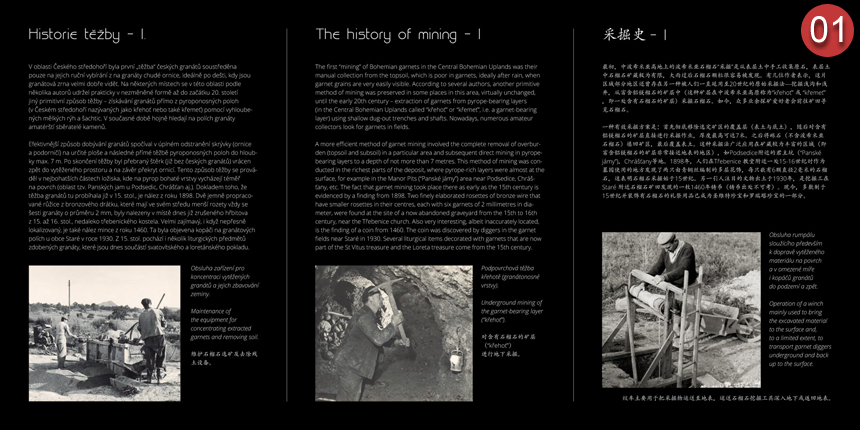
Maintenance of the equipment for concentrating extracted garnets and removing soil.
Underground mining of the garnet-bearing layer (“křehoť”).
Operation of a winch mainly used to bring the excavated material to the surface and, to a limited extent, to transport garnet diggers underground and back up to the surface.